Jungian Analysis
Jungian analysis brings what’s unconscious into awareness, helping you move toward balance, meaning, and relief from psychological suffering.
Jung was among the first to show that the mind is a multiplicity. Active imagination, his method for dialoguing directly with our sub-personalities and unconscious material, remains central to this work. Its goal, individuation, is Self-realisation: becoming who you actually are.
Internal Family Systems
The mind is made of multiple parts.
The Self guides the way.
Essentially, we have all been traumatised in some form at some point, each carrying wounds deep within ourselves, each working hard to keep the pain of those experiences at bay. These are burdens carried by our Exiles.
We are each susceptible to being triggered, to overreacting when the old wounds of Exiles resurface. We also each have the Self: our core, our essence, an internal compass with its own wisdom and capacity to heal.
Complex PTSD is an attachment and relational violation. It disrupts our sense of safety and trust in the world, and limits our access to connection. The goal of IFS is self-realisation and the recovery of our ability to connect and belong.
"The psyche is not an indivisible unity but a divisible and more or less divided whole. Although the separate parts are connected with one another, they are relatively independent."
— C.G. Jung, CW 8, para. 582
Camilo Gallardo Dip. Analytical Psychology — IAAP · GAP · UKCP
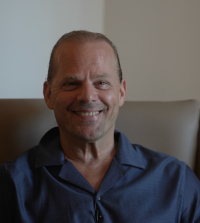
In the late 1980s I moved to Los Angeles to study Meisner and become a filmmaker, and it was there, while working as an actor, that I moved into the Dharma Zen Centre and began a daily Zen practice under Master Seung Sahn.
In 1994 and 1996 I travelled to Peru to learn from the shaman Agustín Rivas and work with plant medicine. From that descent into the unconscious I wrote and directed Inscape, a short film, and later another one called 47 Years in Tibet, narrated by John Cleese with music by Ryuichi Sakamoto.
To continue the study of the unconscious, I moved back to London and began training as a Jungian analyst in 1998. I have been in practice for over 25 years now, working more than 20,000 clinical hours, also working as a training analyst and supervisor for Jungian analysts in training.
A trauma-informed revolution
Trauma became a particular focus early on. I first studied trauma constellations with Franz Ruppert, then trained extensively in Internal Family Systems across multiple levels and with several of the model's leading teachers, including Paul Ginter, Cece Sykes, Frank Anderson and Richard Schwartz, the founder of IFS.
More recently I've been training with Thomas Hübl, learning to work as a collective trauma facilitator — extending the same inquiry from the individual psyche to the collective and ancestral burdens we all carry, through his Timeless Wisdom Training (TWT).
Synthesis
Today my work sits at the intersection of these threads. Jungian analysis offers a symbolic and archetypal container, a path to individuation and Self-realisation; IFS offers a practical road map of parts and Self, a path to healing a burdened system; predictive processing offers a third lens, drawn from the neuroscience of how the brain constructs experience through prediction and error. Together they point to how trauma reshapes the very models the mind uses to anticipate the world. As a Collective Trauma Facilitator, I bring this same synthesis beyond the individual session, into the families, communities, and generations through which trauma moves.
Film and Production
These days I also work as a creative consultant and producer on projects sitting at the intersection of psychology, healing, and storytelling — bringing the same clinical grounding into film.
INTERVIEWS
Conversations on trauma, healing, and the unconscious.
The Trauma-Informed Revolution
A conversation on trauma, the unconscious, and what it means to work in a trauma-informed way.
The Grief Revolution
A conversation on grief, shame, and loss — and what it means to let them move through us rather than around us.
Patriarchy and the Wound
On being born into patriarchy, vulnerability, shame, and dissociation — and what therapy asks of us in return.
Death, Rebirth, and Ayahuasca
A personal story of the search for connection, unprocessed unconscious material, and the ayahuasca experience.
From Clients
"There's Camilo Gallardo, who is a rock and a magician. Who sat with me, hour after hour, year after year, through the highs and the lows, through the confusion, the nightmares, and the eventual clarity — who was especially there for me when I dove head first into the inferno. He is my Virgil, my fearless companion, who told me these words by C.G. Jung: 'I am not what happened to me, I am what I choose to become.' Thank you, my friend. I wouldn't be here without you."
Wolf Marloh — Portrait/Headshot Photographer and Writer
"I did want to share that my therapeutic experience of IFS — your presence, holding, and creativity — was massively positive. The process bypassed the mind and cut to the core of authentic unconscious processes. It did not leave me 'high and dry' to make an intellectual evaluation of it all. Quite the opposite — your unconditional holding, trust, and wise guidance navigated the reconnection process, which was, and continues to be, hugely healing."
Client testimonial
Session Booking See Terms of Service
Book & payContact
"You can search throughout the entire universe for someone who is more deserving of your love and affection than you are yourself, and that person is not to be found anywhere. You, yourself, as much as anybody in the entire universe, deserve your love and affection." — Buddha